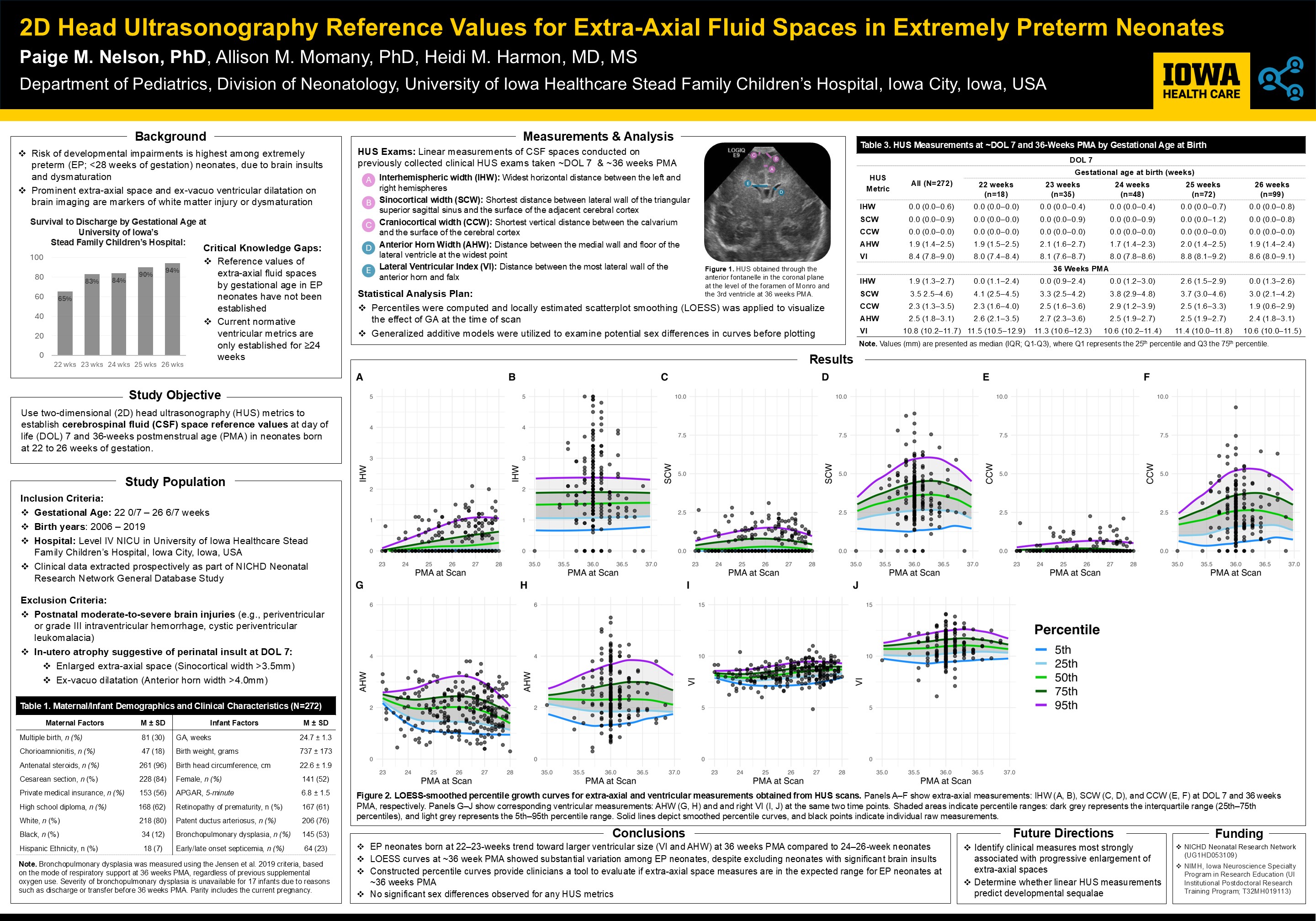

Background: Risk of developmental impairments is highest among extremely preterm (EP; <28 weeks of gestation) neonates, due to brain insults and dysmaturation. Prominent extra-axial space and ex-vacuo ventricular dilatation on brain imaging are markers of white matter injury or dysmaturation; However, Reference values of extra-axial fluid spaces by gestational age in EP neonates have not been established. Current normative ventricular metrics are only established for neonates ≥24 weeks.
Objectives: Use two-dimensional (2D) head ultrasonography (HUS) metrics to establish cerebrospinal fluid (CSF) space reference values at day of life (DOL) 7 and 36-weeks postmenstrual age (PMA) in neonates born at 22 to 26 weeks of gestation.
Design/Methods: The study population consisted of neonates gestational ages 22 0/7 - 26 6/7 at University of Iowa Healthcare Stead Family Children's Hospital Level IV NICU born between 2006-2019. Individuals with postnatal moderate-to-severe brain injuries or in-utero atrophy suggestive of perinatal insult were excluded. Linear measurements of CSF spaces were conducted on previously collected clinical head ultrasound exams taken ~DOL 7 and ~36 weeks post menstrual age. Percentiles were computed and locally estimated scatterplot smoothing (LOESS) was applied to visualize the effect of GA at the time of scan. Generalized additive models were utilized to examine potential sex differences in curves before plotting
Conclusions: EP neonates born at 22–23-weeks trend toward larger ventricular size (VI and AHW) at 36 weeks PMA compared to 24–26-week neonates. LOESS curves at ~36 week PMA showed substantial variation among EP neonates, despite excluding neonates with significant brain insults. Constructed percentile curves provide clinicians a tool to evaluate if extra-axial space measures are in the expected range for EP neonates at ~36 weeks PMA. No significant sex differences were observed for any HUS metrics.
Future Directions: Future work should aim to identify clinical measures most strongly associated with progressive enlargement of extra-axial spaces. Studies may also determine whether linear HUS measurements predict developmental sequalae.